Click here to show or hide the menubar.
Thread started by Dave Winer on Monday, October 08, 2012.

They taught outlining wrong

In school they taught us to outline first, then write from the outline. It's an ideal no one achieves, because it's impossible to have the essay arrive in finished form in our mind before we start writing. It doesn't work that way.

Instead we wrote the paper first, then the outline.

And that was correct, because it was the only way that worked. But it didn't get us much more than a slide show presentation of our work. It's different when you have a structure editor, an outliner. Because you can revise both the text and its organization after the initial burst of writing.

Here's how I do it today, in my outliner. I write from top to bottom. Then I review. If I find structure, I add it.

Then I have a structure to work with, I add more ideas become apparent, more things I have to record, to tell the reader. The order might change. The process of each little project is to iterate both the work product and the narration until I feel I'm ready to move on to the next thing.

Of course I might start two or more things at the same time. For example I have two worknotes open now, and this blog post.

In a blog post I play with order more than structure. They are meant to be read from top to bottom, as a story.

But worknotes offer different things to different people. I write them for today's users and hopefully tomorrow's too. But I also write them for developers, including myself, who will continue to work on the code behind the notes. I find it very useful to be able to open my notes from a previous project, while working on something related, and find it all neatly organized, so I can skip right to the part that's relevent to me.

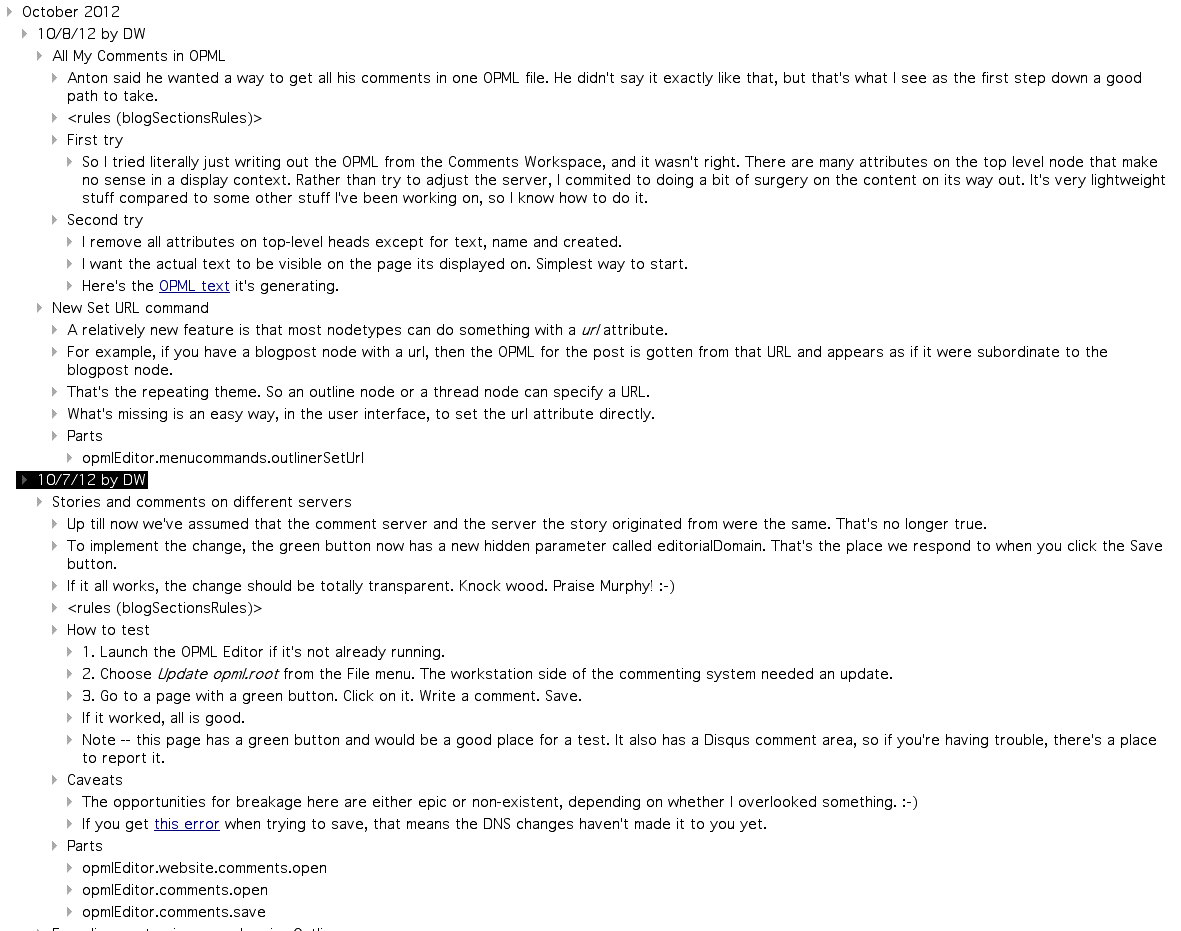
I thought it would be interesting to take a screen shot of my worknotes outline so you can see what projects in various states of completion look like. At the same time here's one of my blog outline. See how they're different?

Outlining works on a computer, as long as you revise. It doesn't work on paper because revision, especially of structure, is too hard.
Amyloo permalink

Like Ted, I was an outlining rebel, or thought I was, but when I look at my old handwritten notes, darned if they don't look like outlines.

What I like most about the OPML Editor as a writing tool is that your notes can become your post, or article, or review or whatever the final product may be.

Zach Thomae permalink

I see this problem a lot, but not for writing papers. Most everyone I know has already realized that they can save time without making the paper much worse by skipping it.

I guess this shouldn't surprise me--we were only taught what an outline looked like and only as an individual "thing," so most of the power of the outlines we know about here were ruled out from the start. And even though we wrote our outlines on the computer, MS Word was too much like a piece of paper to get past paper's limitations. Even if we had imagined a better way of outlining, we just didn't have the tools to do it.

It's almost like an accident that the kind of outlining we were taught in school works well enough for the kinds of papers we were writing, with a flat organization and limited room for details that would run up against the limits of the page. And of course you would use it to plan, because manipulating snippets of text larger than a sentence or two becomes unwieldly.

But I see this degenerate form of outlining show up a lot in taking notes. This is a perfect use case for proper outlining--great for writing because you can organize quickly, and great for reading because you can organize well--but it won't work if you have to stay on the page.

The outlines always come out organized chronologically, usually with about-even blocks of time making up each level of the hierarchy. The presentation is treated like an old school paper, even though the organization of the presentation could be nothing like the old papers. This is almost never the best way to do it, and it looks primitive if you know what could be.

The Blub paradox strikes again.

With the right tool, an outline is more than a formatting rule--it's a way of thinking and working. The idea of outlining, of strongly organized, hierarchical information, really has nothing to do with what we were taught in school about outlines. It's not about planning papers (pre-summarizing is probably a better word for it), or about the depthwise ordering of letters and numbers.

But because that's what we were taught, taking advantage of a real outliner is unintuitive and non-obvious. And if you can't think of it, how could you ever know how to look for it?

As a member of the first generation that could've been taught outlining well, I would go even farther than you. They didn't merely teach us how to outline wrong--they didn't even tell us what an outline really is.

Ted C. Howard permalink

Of all the things I've learned working with you, this is probably the most important. I never thought I'd be an outliner, but I totally am. Writing this way just makes sense.

XML
Stats -- Atts